LingoAI KeyboardLingoAI
Back to Blog

Spanish Learning

The Complete Guide to Passive Spanish Learning (2026)

A practical framework to learn Spanish through daily behavior, with no dedicated study block required.

February 18, 20262,169 words • 10 min read

Learning Spanish doesn't have to mean sitting down to study. This guide shows you how to build real Spanish vocabulary through the things you already do every day.
Passive Spanish learning through contextual typing
Passive input works best when Spanish appears in communication you already do every day.

If you've tried Duolingo, Babbel, or a Spanish class — and quit — you're not alone. Research shows that over 80% of language learners abandon structured study within the first month. Not because they stopped wanting to learn. Because the method didn't fit their life.

This guide is about a different approach: passive Spanish learning. It's not a shortcut or a gimmick. It's a framework grounded in how the brain actually acquires language — and it works precisely because it doesn't ask you to carve out extra time.

1. Why Traditional Spanish Learning Fails Most People

Before diving into the solution, it's worth understanding the real problem.

Most Spanish learning tools are designed around deliberate study sessions: open the app, complete a lesson, close the app. This model has three fundamental flaws:

  • It competes with your time. A 20-minute daily study habit sounds small until it's 10 PM and you're exhausted.
  • Context is artificial. Matching flashcards in an app has little connection to the Spanish you'd actually use in a real conversation.
  • Retention is poor without real-world application. The forgetting curve (first described by Hermann Ebbinghaus in 1885) shows that without reinforcement in context, we forget ~70% of new material within 24 hours.

Passive learning addresses all three of these problems directly.

2. What Is Passive Spanish Learning?

Passive Spanish learning is the practice of acquiring Spanish vocabulary, phrases, and intuition through your existing daily behaviors — without setting aside dedicated study time.

The core idea comes from linguist Stephen Krashen's Input Hypothesis: language is acquired most effectively when learners are exposed to comprehensible input slightly above their current level, in a meaningful context. You don't learn language by memorizing rules — you absorb it by encountering it repeatedly in situations that make sense to you.

Passive learning works by embedding Spanish into activities you already do:

  • Sending messages
  • Browsing the internet
  • Watching content
  • Listening while commuting

The result is vocabulary and phrases that feel intuitive, because you learned them in context — not in isolation.

Passive vs. Active Learning: Key Differences

Dimension Active Learning Passive Learning
Time required Dedicated sessions (20–60 min/day) Embedded in existing activities
Context Artificial (app environment) Real-world (your actual life)
Retention Lower without active recall Higher due to contextual memory
Sustainability Dependent on motivation & discipline Runs on habit & routine
Best for Grammar rules, structured vocabulary Natural vocabulary, phrases, intuition

The most effective learners combine both. But for people with busy lives, passive learning is often the only approach that actually sticks.

3. The 5 Methods of Passive Spanish Learning (Ranked by Effectiveness)

Method 1: Spanish Podcasts & Audio Content

Effectiveness: ⭐⭐ (Low–Medium)

Listening to Spanish podcasts during your commute or workout is the most popular passive learning method — and the hardest to benefit from as a beginner.

The problem: if you can't understand what's being said, your brain tunes it out. Incomprehensible input is essentially background noise.

When it works: Once you reach an intermediate level (~500 words), podcasts like Coffee Break Spanish, Notes in Spanish, and SpanishPod101 become genuinely useful.

Best picks for beginners: Podcasts that mix English explanation with Spanish examples, like Language Transfer (free, highly regarded).

Method 2: Spanish TV, Film & YouTube

Effectiveness: ⭐⭐⭐ (Medium)

Visual context makes comprehension dramatically easier. You can infer meaning from expressions, setting, and action — which is exactly what Krashen's Input Hypothesis predicts.

Best practices:

  • Start with English subtitles, then switch to Spanish subtitles, then no subtitles
  • Dreaming Spanish on YouTube is specifically designed for comprehensible input at varying levels
  • Netflix shows like Money Heist or Club de Cuervos work well at intermediate level

Limitation: This is a consumption method — you're not producing Spanish, so speaking and writing skills develop slowly.

Method 3: Language Exchange Apps (HelloTalk, Tandem)

Effectiveness: ⭐⭐⭐ (Medium)

These apps connect you with native Spanish speakers who want to learn English. You help each other.

Why it works: Real conversations with real people create strong contextual memory. A phrase you use to make a new friend sticks far better than the same phrase on a flashcard.

Honest limitation: It requires scheduling, social energy, and the willingness to make mistakes in front of a stranger. For many people, this friction is too high to sustain.

Method 4: Changing Your Phone & App Language to Spanish

Effectiveness: ⭐⭐⭐ (Medium)

A surprisingly effective — and completely free — method. Your phone's interface is something you interact with dozens of times a day. Switching it to Spanish means encountering words like Configuración (Settings), Buscar (Search), and Eliminar (Delete) hundreds of times a week.

Why it works: Repetition in context. You always know what the button does, so the Spanish word maps directly to a real action.

Limitation: Interface vocabulary is narrow. You'll learn tech words, but not conversational Spanish.

Method 5: Learning Spanish While You Type ⭐ Most Effective for Busy People

Effectiveness: ⭐⭐⭐⭐⭐ (High)

This is where passive learning becomes genuinely powerful — and where most people haven't looked yet.

The average American sends ~72 text messages per day. That's 72 opportunities to encounter a Spanish word in a context you completely understand, because you chose what to say.

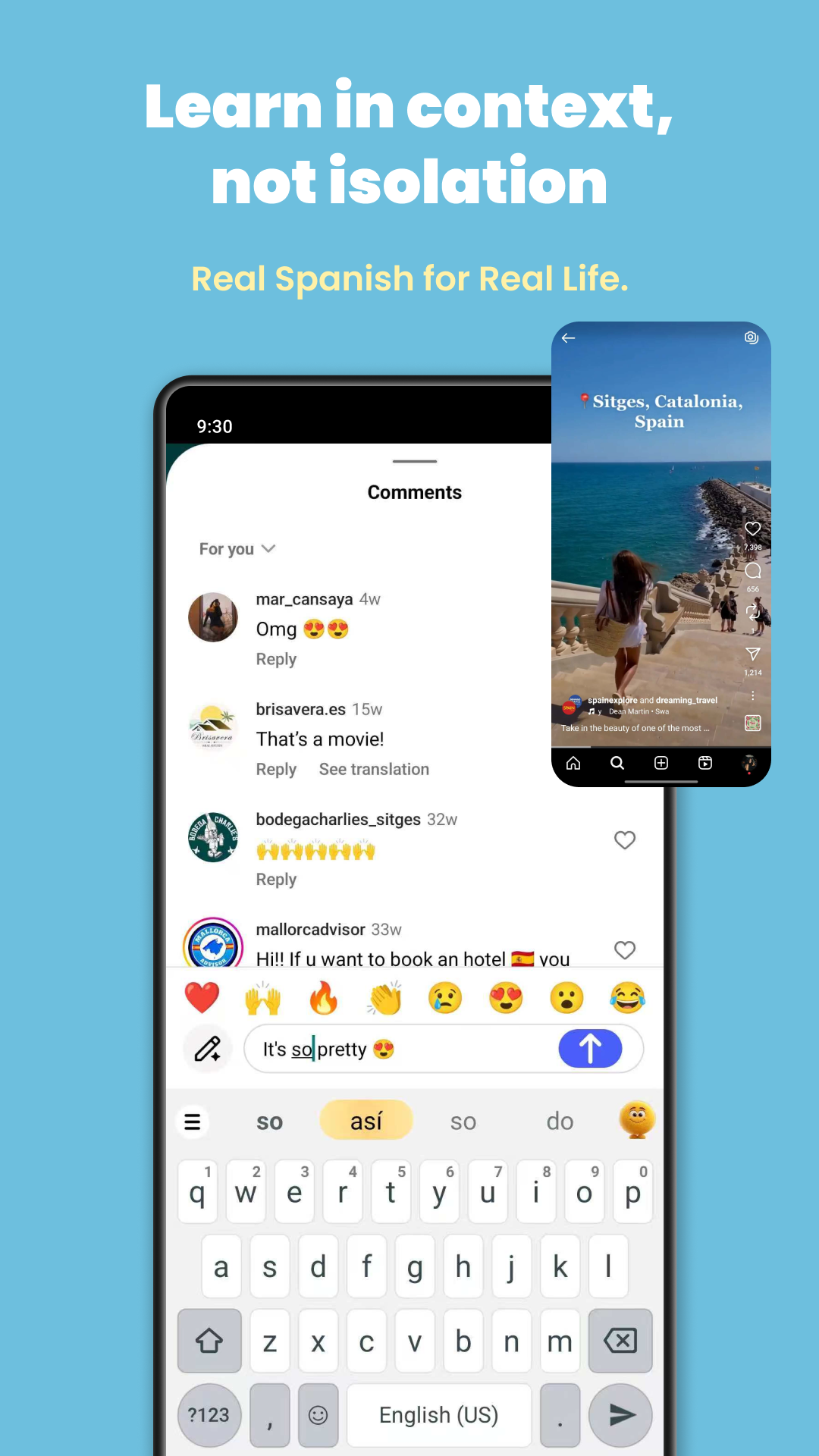
The concept: as you type in English, your keyboard surfaces relevant Spanish equivalents in real time. You see gracias when you type "thanks." You see mañana when you type "tomorrow." You see increíble when you type "incredible." You choose whether to use them — but the exposure is effortless and constant.

This isn't immersion theater. It's vocabulary acquisition embedded in the communication you're already doing.

Passive Input Weekly Dashboard

MetricTargetWhy it matters
Words encountered35-60 / weekBuilds recognition through repeated exposure.
Words used 3+ times12-20 / weekMarks transition from passive to active recall.
Contexts activated2-3 contextsCross-context repetition improves retention durability.
Low-friction sessionsDailySustainability depends on routine fit, not intensity.
LingoAI keyboard suggestions in real context
Contextual keyboard suggestions reduce friction and increase practical word retention.

4. Who Is Passive Spanish Learning Best For?

The Busy Professional

You have 45–60 minutes of commute, a full inbox, and no realistic space in your day for a study habit. Passive learning doesn't compete with your schedule — it runs inside it.

The Duolingo Dropout

You've started (and stopped) language apps multiple times. The issue isn't your motivation — it's that app-based learning requires you to show up on the app's terms. Passive learning shows up on yours.

The Upcoming Traveler

You're visiting Mexico City, Buenos Aires, or Barcelona in three months. You want to order food, ask for directions, and not feel helpless. 300 high-frequency words learned in context will serve you far better than 300 flashcards memorized in isolation.

The Heritage Learner

You grew up hearing Spanish at home but never formally learned it. Passive exposure reactivates dormant vocabulary faster than any structured course.

The Language Enthusiast with a Plateau

You've hit a ceiling with your current method. Passive input — especially in your own natural communication style — helps break through intermediate plateaus by expanding vocabulary in authentic contexts.

5. How to Build Your Passive Spanish Learning System (Step-by-Step)

The goal is to embed Spanish into behaviors you already do reliably — not to add new behaviors.

Step 1: Audit Your Daily "Language Behaviors"

Write down everything you do that involves language:

  • Texting friends and family
  • Writing emails or Slack messages
  • Searching Google
  • Watching YouTube or Netflix
  • Listening to music or podcasts

These are your passive learning slots. You're looking for the ones with the highest frequency and lowest switching cost.

Step 2: Choose 1–2 Slots to Activate First

Don't try to convert everything at once. Pick the slot where Spanish exposure will feel least disruptive.

For most people, this is messaging — because the context is fully known (you're talking to someone you know, about something you already understand) and the frequency is high.

Step 3: Start with High-Frequency, High-Emotion Words

Not all Spanish words are created equal for passive learning. Prioritize:

  • Emotional words (increíble, perfecto, qué lástima) — strong emotional context = strong memory
  • Social words (gracias, claro, por supuesto) — used constantly in messaging
  • Action words (vamos, espera, ayuda) — short, memorable, high utility

Avoid starting with grammar rules or conjugations. Let vocabulary come first — grammar follows naturally through exposure.

Step 4: Track Progress in the Simplest Way Possible

You don't need a complex system. Just track:

  • Words encountered this week
  • Words you've used at least 3 times (these are becoming yours)

Setting a micro-goal — I want to own 50 Spanish words by the end of Month 1 — gives passive learning a direction without turning it into homework.

Step 5: Expand Gradually

Once messaging feels natural, expand to a second slot (e.g., switching your phone's search language, or adding a Spanish podcast to your commute). Passive learning compounds — the more contexts a word appears in, the more deeply it's encoded.

Daily passive Spanish learning loop for busy users
A lightweight routine is easier to sustain than high-effort study sessions.

6. Common Myths About Passive Spanish Learning

❌ Myth: "You can become fluent through passive learning alone."

Reality: Passive learning is exceptional for vocabulary and listening comprehension. For speaking fluency, you'll eventually need active practice — conversations, pronunciation work. Think of passive learning as building the foundation; speaking practice is the structure you build on top.

❌ Myth: "Passive learning means no effort at all."

Reality: There's a difference between effortless and zero effort. Passive learning removes the scheduling burden and the motivational dependency. But paying attention when a Spanish word surfaces, and choosing to engage with it, is a small but real form of active participation.

❌ Myth: "If I'm not studying grammar, I'm not really learning."

Reality: Children acquire their native language with zero formal grammar instruction. Grammar is an explanation of patterns you've already internalized — not the gateway to understanding. Most everyday Spanish communication requires a relatively small grammatical toolkit, most of which can be absorbed through sufficient input.

❌ Myth: "Passive learning takes too long to see results."

Reality: Contextual vocabulary acquisition is faster than it sounds. Studies on incidental vocabulary learning (Nation, 2001; Webb, 2007) suggest that a word encountered in context 8–10 times is reliably retained. If you send 70 messages a day and encounter a Spanish word 3–5 times per day, you can own that word in under a week — without any deliberate study.

7. Frequently Asked Questions

Can I really learn Spanish passively?

Yes — with realistic expectations. You can build a strong vocabulary base (500–1,000 words), develop listening comprehension, and become comfortable with Spanish in everyday contexts through passive learning alone. Speaking fluency requires additional active practice, but passive learning dramatically accelerates the process.

How long does passive Spanish learning take?

Most people notice meaningful vocabulary growth within 4–6 weeks of consistent passive exposure. Reaching conversational vocabulary (1,000–2,000 words) typically takes 4–8 months depending on the frequency and quality of exposure.

Is passive learning better than Duolingo?

They serve different purposes. Duolingo is good for structured grammar and accountability streaks. Passive learning is better for vocabulary retention and sustainability. The honest answer: passive learning has a better completion rate, because it doesn't compete with your willpower.

What's the best tool for passive Spanish learning while typing?

LingoAI is a keyboard designed specifically for this use case — it surfaces relevant Spanish words as you type in English, so you're learning in the context of your own messages. It's available on Android (Google Play) and is built specifically for English speakers learning Spanish.

Do I need to know any Spanish to start?

No. Passive learning is especially effective at the beginner stage, because high-frequency words are encountered repeatedly and the context (your own messages and daily life) makes meaning immediately clear.

Can passive learning work for other languages besides Spanish?

Yes. The principles apply to any language. Spanish is a particularly strong candidate because of its prevalence in American daily life — you're likely already encountering Spanish in the real world, which multiplies passive exposure opportunities.

8. The Bottom Line

Passive Spanish learning isn't magic, and it isn't a replacement for all forms of practice. But for the large majority of people who want to learn Spanish and keep quitting — it's the most realistic path forward.

The core insight is simple: you already have the time. You're already sending messages, listening to things, watching content, moving through the world. Passive learning asks you to let some of that existing activity become a language classroom.

Start small. Pick one slot. Pay attention when Spanish appears. The rest builds itself.

Last updated: February 2026. This guide reflects current research on second language acquisition and passive learning methodology.