
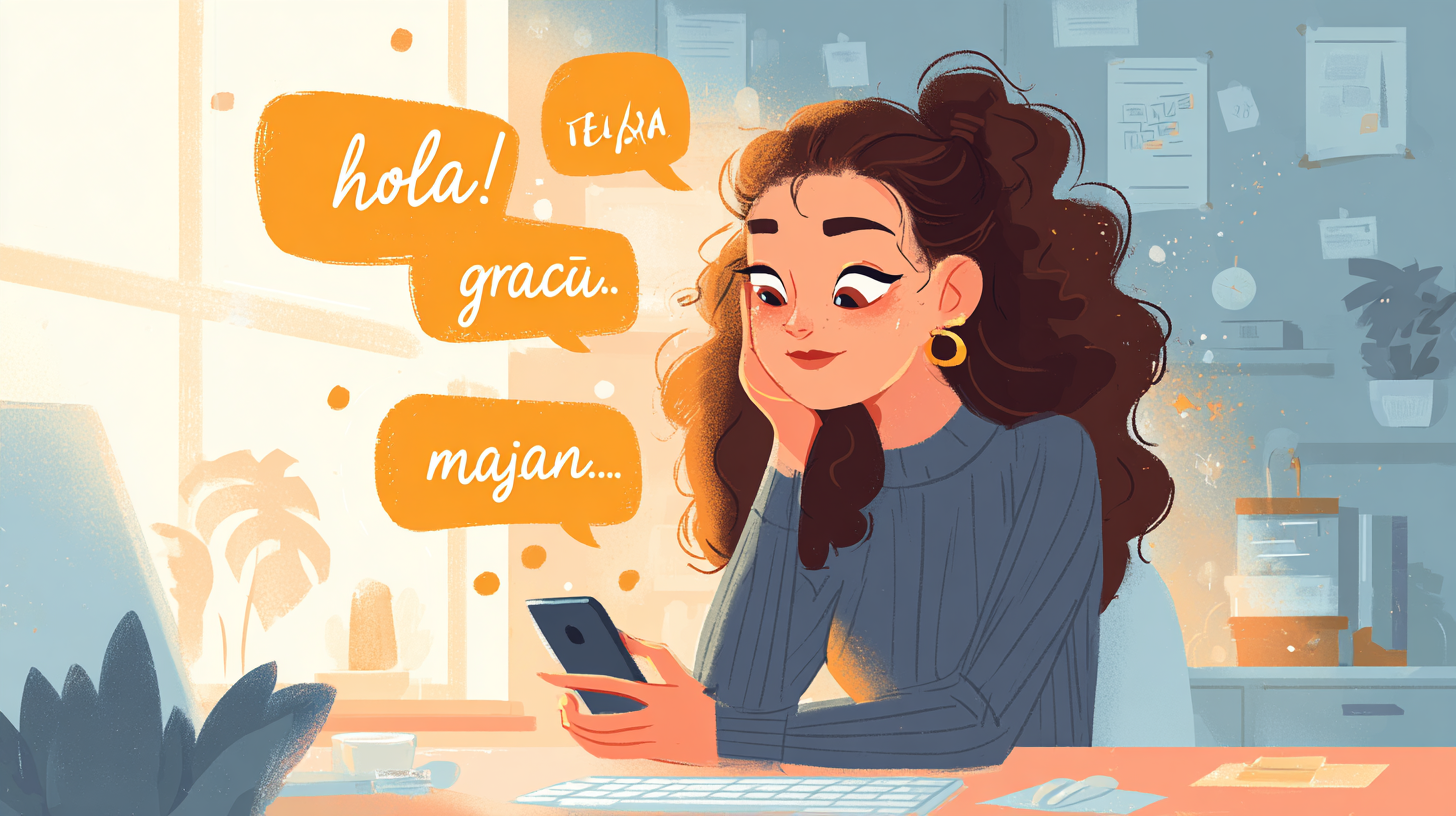
Most people do not quit Spanish because they lack motivation. They quit because the learning model they picked fights their schedule, creates friction, and quietly raises anxiety every time they fall behind.
Passive learning offers an appealing promise: If I surround myself with Spanish, it will eventually sink in. That intuition is directionally right. Comprehensible input does help. But it leaves out the part most adult learners actually struggle with: getting Spanish back out under real conditions.
The real gap is not exposure. It is what happens after exposure:
- Passive Spanish learning improves recognition.
- Fluency requires retrieval and production.
- Production requires practice that happens often, in context, and without fear.
So the most useful question is not What content should I consume? It is: Where can meaningful practice happen with near-zero friction and near-zero anxiety?
For busy adults, the best answer is usually the place they already spend their attention: the keyboard.
1. What Krashen got right about passive input
Stephen Krashen's Input Hypothesis remains one of the most important ideas in second-language acquisition. His core claim is simple: people acquire language by understanding messages, not by memorizing isolated rules.
Comprehensible input works because it gives you language that is just beyond your current level: Krashen's famous i+1.
This is why podcasts, videos, graded readers, and immersion-style content genuinely help with comprehension. They expose you to large amounts of language in context. That part of passive learning is real.
The problem is not that passive input fails. The problem is that passive input mostly builds the system for understanding. Speaking and writing ask for a second step: producing language under real constraints.
2. The affective filter is the hidden bottleneck
Krashen's Affective Filter Hypothesis explains why smart, motivated learners still freeze when it is time to use Spanish. Anxiety, self-consciousness, and fear of making mistakes can block input from being processed deeply enough to stick.
That is why so many adults recognize this pattern:
- You understand the lesson.
- You know the word when you see it.
- You still cannot retrieve it smoothly in a real conversation.
The filter rises the moment the task feels like performance. This is why casual exposure often feels easier than study apps. It is not always more powerful. It is simply lower pressure.
The ideal practice environment has both real context and low stakes. That combination matters more than most people realize.
3. Input is necessary. Output is what closes the loop.
Merrill Swain's Output Hypothesis filled in the gap. Comprehensible input is necessary, but not sufficient. Learners also need chances to produce language, because production forces a different type of processing.
- Input lets you glide past what you only partly understand.
- Output forces precision. You cannot skip a word you need to use.
When you try to say something and realize you do not have the right word, you notice the gap. That noticing is itself a learning event. Passive listening rarely creates enough of those moments on its own.
Production does not just reveal what you know. It reveals what is still missing, and that is what pushes acquisition forward.
4. Retrieval is the mechanism that makes Spanish usable
Cognitive science lands in the same place. The retrieval practice effect shows that trying to recall something improves long-term retention more than simply reviewing it again.
Applied to language, the difference looks like this:
- Hearing hola again and again builds familiarity.
- Typing hola in a message when it actually fits builds recall.
Both matter. But the second is what turns passive recognition into active availability. The challenge is that most retrieval practice systems come with friction: open the app, start the lesson, protect the streak, repeat tomorrow.
That friction is exactly what breaks the habit for busy adults.
5. Why practicing where you already type changes everything
Most adults already repeat one language behavior at very high frequency:
- texting
- emailing
- searching
- writing notes
- posting and replying
You may not have 20 extra minutes for a lesson. But you probably type hundreds of times per day. That changes the economics of practice.
- Real context lowers the affective filter. You are communicating, not performing.
- Output in context activates acquisition-friendly processing. The words are tied to meaning that matters now.
- High frequency creates retrieval practice at scale. Tiny moments compound.
If Spanish practice can show up inside an existing typing habit, the hardest part of learning disappears: starting.
6. A simple framework: exposure, learning, retrieval, integration
The easiest way to compare methods is to sort them by the mental job they actually perform.
| Category | What it activates | Typical tools | Common failure mode |
|---|---|---|---|
| Exposure | Comprehensible input; recognition building | Podcasts, YouTube, TV | You understand more, but output does not improve enough |
| Conscious learning | Rule awareness and monitoring | Grammar books, Duolingo lessons | Knowledge about the language does not become automatic use |
| Retrieval practice | Recall under light pressure | Flashcards, Anki, drills | High friction and low real-world context |
| Integration | Low-filter output in real context | Typing-embedded practice | Works only if surfaced vocabulary is relevant and timely |
Passive input remains valuable. But once exposure exists, the next lever is integration: using Spanish where your real behavior already happens.
7. Comparing passive input, Duolingo, flashcards, and typing-based practice
| Approach | Trigger | Extra time | Affective filter | Best for |
|---|---|---|---|---|
| Passive input | Play content | Low | Low | Comprehension, familiarity, comfort |
| Duolingo-style lessons | Open an app | Medium | Medium to high | Structured beginners, rule learning |
| Flashcards | Start a session | Medium | Medium | Deliberate recall with discipline |
| Practice where you type | Type as usual | Very low | Very low | Busy learners who need frequency and real context |
If your main bottleneck is consistency and anxiety rather than raw motivation, the best method is usually the one with the lowest filter and the highest natural frequency. If the bottleneck is freezing before a reply, use a structured recall Spanish speaking practice loop or the no-speaking-partner output loop before you try to force longer conversations.
8. What typing-based practice actually looks like
Typing-based Spanish practice is not about forcing yourself to write essays in Spanish. It is about creating a daily trickle of real retrieval moments:
- you see a Spanish word when you would normally type an English one
- you choose to use it in a real message
- the same words reappear across different contexts
- recall gradually becomes automatic
It is small, but it is frequent. And for adults with crowded schedules, frequency beats intensity surprisingly often. For casual chat practice, the Spanish texting abbreviations reply loop turns real WhatsApp-style messages into short retrieval reps.
9. Where LingoAI fits in the system
LingoAI is built around the exact conditions this research points toward: real context, low stakes, and high frequency.
That means a keyboard that supports Spanish retrieval inside your existing communication flow, instead of asking you to create a separate study ritual.
For the product-level workflow, see what LingoAI is and how the keyboard turns normal typing into a practice surface.
What it is
- A Spanish-learning keyboard that surfaces useful words when context already exists
- A lightweight output loop embedded in texting, searching, and note-taking
What it is not
- Not a replacement for podcasts, videos, or other comprehensible input
- Not a grammar course
- Not a claim that typing alone creates fluency
Who benefits most
- Busy professionals who already have some input but cannot sustain a separate practice habit
- People who quit streak-based apps because friction and anxiety kept winning
- Learners who understand more Spanish than they can actively produce
10. A 7-day experiment with no extra study block
If you want to test this idea without overhauling your routine, try a simple seven-day experiment:
- Day 1-2: Notice how many times you type in a day. Do not change anything yet.
- Day 3-4: Pick 10 high-frequency words you already recognize but rarely produce.
- Day 5-7: Use one or two of those words in real messages when they genuinely fit.
The takeaway
Krashen was right that comprehensible input is fundamental. Passive listening, easy reading, Spanish TV, and background exposure all matter.
But the research is equally clear: input alone does not produce output.
You also need production. In real context. With low anxiety. Often. The easiest production habit to sustain is the one that appears inside what you already do every day, especially typing.
Related reading: The Complete Guide to Passive Spanish Learning